Album
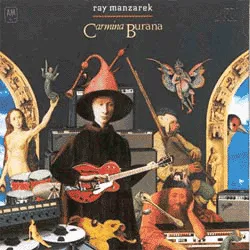
Ray Manzarek - Carmina Burana
1983 · LP · A&M Records
- Released
- 1983-01-01
- Origin
- US
- Format
- LP
- Label
- A&M Records
- Catalog #
- SP-4945
- Country
- US
About This Album
Ray Manzarek's Carmina Burana, released in 1983 on A&M Records under catalog number SP-4945, is a US pressing LP that sits well outside the mainstream of his solo catalog. This is not a reissue or a live document; it is an original studio recording, pressed and distributed domestically, adapting Carl Orff's iconic 1937 cantata into something distinctly Manzarek's own. If you are hunting specifically for this US A&M pressing, that SP-4945 number is your primary identifier, and it separates this copy from the other regional variants cataloged here on DoorsInfo, including this variant and this one.
The physical package is understated by the standards of A&M's early 1980s output. The sleeve presents a painterly, somewhat surreal cover image that leans into the medieval and mythological themes of the source material, consistent with Orff's original intent but filtered through a distinctly early-80s aesthetic sensibility. The typography on the front is clean and period-appropriate, with Manzarek's name and the title given roughly equal weight, signaling that A&M was positioning this as a legitimate solo artistic statement rather than a novelty side project. The back cover carries the track listing with both the English adaptation titles and the original Latin titles in parentheses, a thoughtful touch that gives the sleeve itself some scholarly utility. The record comes issued with a 4-page insert that includes the full lyrics and production credits. The lyric sheet is essential here given the bilingual nature of the record; the English adaptations are credited and the Latin originals are noted with their proper copyright attribution to B. Schott's Soehne, with licensing handled through European American Music Distributors Corp. The vinyl itself, on a well-preserved copy, tends to be quiet, consistent with A&M's pressing quality in this period. The label design follows standard A&M early-80s formatting. Collectors should examine the insert carefully when buying used copies, as it is frequently missing and materially affects the completeness of the package.
What Manzarek does with Orff's material is genuinely singular in his solo discography. The 16 tracks, organized across four named sections (Destiny: Ruler of the World, Springtime, In the Tavern, and The Court of Love), follow Orff's original structural logic while Manzarek applies electronic keyboards, rock sensibility, and his own compositional instincts. The opening and closing bookend of The Wheel of Fortune (O Fortuna) mirrors Orff's structure directly. The track sequence across both sides is well-constructed; side one moves through the fate and springtime sections, while side two handles the tavern and love court material before returning to the O Fortuna theme. Stylistically, this record sits at an unusual intersection, which is reflected in its Discogs genre tags: Electronic, Rock, Folk Rock, Modern Classical, Abstract, and Art Rock. That spread is not an error; the record genuinely moves between those registers. For collectors who track Manzarek's solo output chronologically, this follows his earlier work documented on releases like The Golden Scarab and The Whole Thing Started With Rock & Roll, and represents a more classically ambitious step in his solo career. On Discogs, this pressing currently shows 788 collectors marking it as owned and 129 with it on their want list. That ratio suggests reasonable availability in the used market, though condition-grade copies with the complete insert will cost more. It is not a scarce record in the way that a limited pressing would be, but a clean copy with the lyric sheet intact is not always easy to locate.
This US A&M pressing of Carmina Burana (SP-4945) is a worthwhile addition to any serious Manzarek solo collection. It is an official commercial release from a major label, musically distinct from anything else in his catalog, and complete copies with the 4-page insert are the ones worth seeking. It will not be the most played record on your shelf, but it occupies a legitimate and interesting place in the broader Doors-adjacent discography. Buy it complete or pass on incomplete copies unless the price reflects the missing insert.
Log in to leave a comment.