The Doors · Vocals & Lyrics
Jim Morrison
Melbourne, Florida, 1943 – Paris, France, 1971
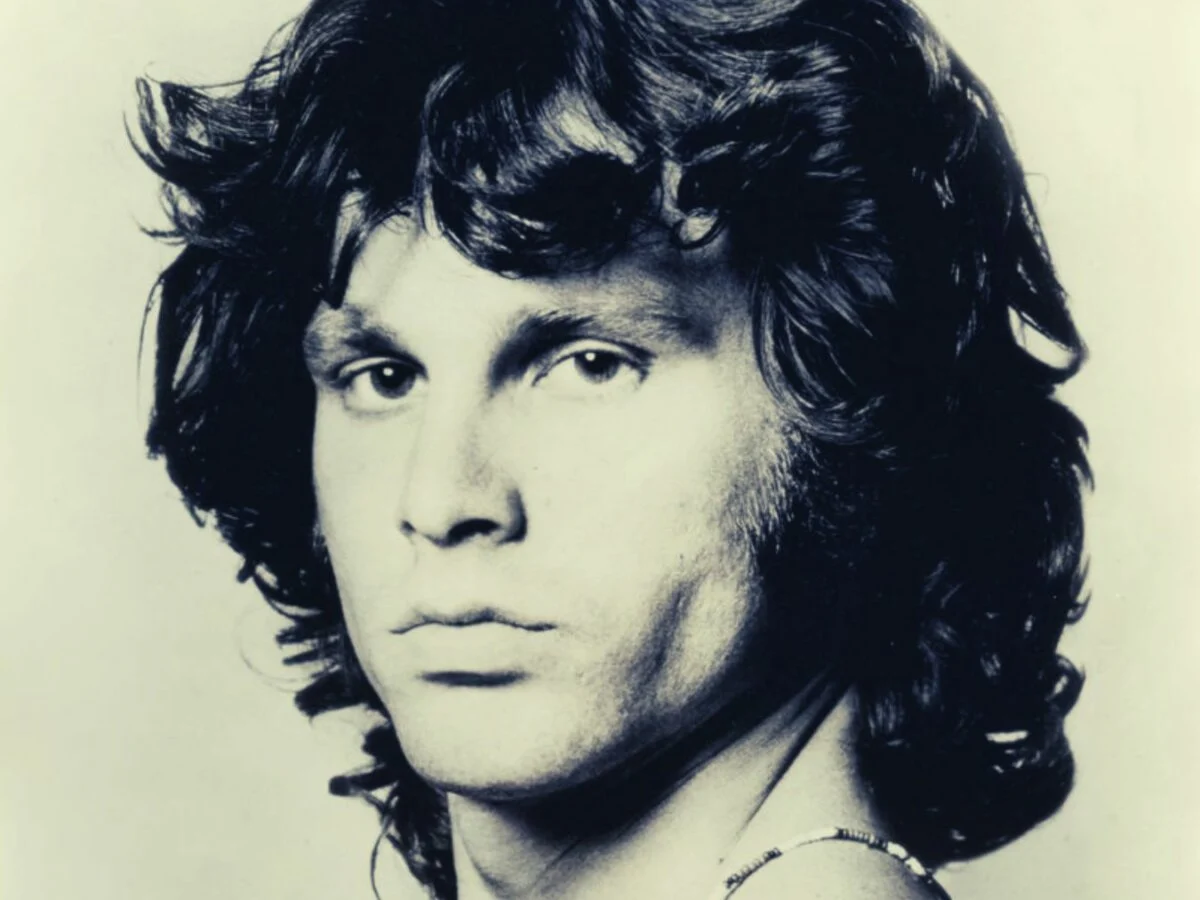
- Born
- December 8, 1943 · Melbourne, Florida
- Died
- July 3, 1971 (age 27) · Paris, France
- Role in The Doors
- Lead vocals, primary lyricist
- Years active
- 1965–1971
- Resting place
- Père Lachaise Cemetery, Paris
- Status
- Deceased · 55 years ago
Early Life
James Douglas Morrison was born on December 8, 1943, in Melbourne, Florida, the eldest of three children of Clara and George Stephen Morrison, a career U.S. Navy officer who later rose to rear admiral. The family moved often with his father’s postings, and Morrison spent stretches of his childhood in Washington, D.C., California, and New Mexico. He read constantly from an early age. Nietzsche, Rimbaud, and William Blake became formative influences he carried into his songwriting. He studied briefly at St. Petersburg Junior College and Florida State University before transferring to UCLA, first into the theater arts program, then into the film school, where he graduated in 1965.
Forming The Doors
Morrison met keyboardist Ray Manzarek at UCLA, and the two crossed paths again that summer on Venice Beach. By his own account, Morrison was penniless and sleeping on rooftops at the time. He sang Manzarek fragments of a song he’d written called “Moonlight Drive,” and Manzarek proposed they form a band. Drummer John Densmore and guitarist Robby Krieger joined later that year, and the four-piece named itself The Doors, after Aldous Huxley’s The Doors of Perception. The About The Doors page covers the band’s formation and rise in full detail.
The Lizard King: Persona and Lyrics
Morrison built a stage persona around confrontation and improvisation, treating live performance as ritual and provocation rather than routine. He wrote or co-wrote most of the band’s catalog, from the radio-friendly “Light My Fire” and “Hello, I Love You” to sprawling, theatrical pieces like “The End” and “When the Music’s Over.” He self-published two volumes of poetry during his lifetime, The Lords and The New Creatures (1969). Editors later published two more collections from his notebooks, Wilderness (1988) and The American Night(1990). Off stage, his heavy drinking and increasingly erratic behavior strained relationships within the band, and both Densmore and Krieger wrote about it candidly in their later memoirs.
The Miami Incident
On March 1, 1969, at the Dinner Key Auditorium in Coconut Grove, Florida, Morrison’s conduct during a chaotic, delayed show led to his arrest days later on a felony charge of lewd behavior, along with several misdemeanor counts including indecent exposure and profanity. A Miami jury acquitted him of the felony in 1970 but convicted him on the two misdemeanors, and a judge sentenced him to six months of hard labor and a $500 fine. He stayed free on appeal for the rest of his life. Courts never resolved the conviction before his death. In December 2010, Florida Governor Charlie Crist granted Morrison a posthumous pardon, calling the original prosecution excessive.
Paris and Death
In March 1971, with the band’s sixth album, L.A. Woman, newly recorded, Morrison moved to Paris with longtime partner Pamela Courson, largely to step back from music and focus on writing. Pamela Courson found him dead in the bathtub of their apartment at 17 Rue Beautreillis on July 3, 1971. He was 27. French officials listed heart failure as the cause of death and never ordered an autopsy. That decision, combined with the small number of witnesses and Morrison’s history of substance use, has fueled decades of speculation and conspiracy theories about his death, including persistent, unsubstantiated rumors that he faked it. No evidence has ever surfaced to support that claim. He was buried on July 7, 1971, at Père Lachaise Cemetery.
Grave and Ongoing Pilgrimage
Morrison’s grave at Père Lachaise remains one of the cemetery’s most visited sites more than five decades later, drawing fans from around the world alongside the graves of Chopin, Balzac, and Oscar Wilde. Vandals have graffitied the site repeatedly over the years, and the cemetery now stations a guard nearby. A bust of Morrison went up at the site in 1981 and came down in 1988 after repeated defacement. The Morrison family has periodically discussed relocating the grave, but as of 2026 it remains at Père Lachaise.
Legacy and Continuing Recognition
Morrison never lived to see the band’s full commercial and critical stature, but The Doors’ catalog has since sold more than 100 million records worldwide, and the Rock and Roll Hall of Fame inducted the group in 1993. Oliver Stone’s 1991 film The Doors, starring Val Kilmer, introduced Morrison to a new generation and cemented much of his public image. In 2025, the surviving members and the band’s archive marked The Doors’ 60th anniversary with a series of remastered releases and the anthology book Night Divides the Day, drawing on Morrison’s original notebooks and journals alongside new interviews with Robby Krieger and John Densmore. Musicians still cite his influence today: the confrontational rock frontman, the poet fronting a rock band, in artists from Patti Smith and Iggy Pop to U2’s Bono.
The Band