- Released
- 1/1/1968
- Origin
- US
- Issue #
- Volume 4, No. 1
- Month
- January 1968
- Publisher
- Capital Records
About This Magazine
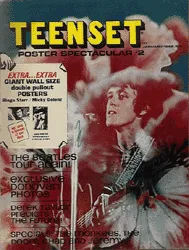
Teenset, Volume 4, No. 1, January 1968, published by Capital Records in the United States. This is a standard newsstand issue, not a promotional or limited variant, carrying the magazine's regular cover price and distributed through the usual teen-magazine retail channels of the period. The specific article of interest to Doors collectors is titled Doors Lore, making this issue one of several Teenset numbers from 1968 that documented the band during their commercial peak.
The cover of this issue is immediately recognizable to anyone who has handled a few copies of Teenset from this era. The masthead runs across the top in bold, uppercase lettering: TEENSET, with a banner below it identifying this as a Poster Spectacular edition, specifically number two in that sub-series. A prominent starburst graphic announces an extra bonus, calling out a giant wall-size double pullout poster featuring Ringo Starr and Micky Dolenz, which tells you everything about the editorial priorities of this publication and its target readership. The cover image itself is a dramatic black-and-white performance shot of a male rock figure, photographed from a low angle mid-stage, the subject caught in motion with long hair and an open shirt. The image has the grainy, high-contrast quality typical of concert photography reproduced on the newsprint-grade paper stock common to teen magazines of this period. The color palette of the cover is muted, leaning into browns, tans, and off-whites, with the red masthead providing the only saturated color accent. Below the central image, cover lines reference exclusive content: mentions of The Beatles and Houdini, a Derek Taylor photo exclusive, and additional editorial promises. The layout is busy and text-heavy in the way Teenset consistently presented its covers during this run, stacking multiple selling points to compete for rack space. Interior pages, as with all issues from this publisher and era, would be printed on uncoated paper that is prone to tanning and brittleness after more than five decades. Collectors acquiring this issue today should expect pages in the mid-to-upper range of the yellowing spectrum unless the copy has been stored flat and away from light. Staple-bound, standard dimensions consistent with the other Teenset issues from 1967 and 1968, including the November 1967 issue documented elsewhere in this catalog.
The editorial draw for Doors collectors is the Doors Lore article, which appears inside this January 1968 issue. By the time this number hit newsstands, The Doors had already released their debut LP and Strange Days, and Jim Morrison's profile in the teen press was rising sharply. Teenset was not a serious rock journal; it was positioned squarely at the teenage market and favored a light, fan-service editorial tone. That context matters when assessing what Doors Lore actually delivers. These articles tended toward brief biographical sketches, trivia-style factoids, and general interest copy aimed at readers who had just discovered the band rather than longtime followers. Do not expect the kind of analytical depth you would find in a contemporary issue of Crawdaddy or later in Rolling Stone. What this piece does offer, for the serious collector, is period documentation: a snapshot of how the band was being presented and packaged for mainstream teen consumption at a specific moment in early 1968, which has genuine historical and archival value.
Teenset ran a notable amount of Doors-related content across its 1968 issues, and this January number sits at the front of that run. Collectors cross-referencing the band's coverage will want to compare this alongside the March 1968 issue, the April 1968 issue, and the May 1968 issue to build a fuller picture of the magazine's coverage arc. The June 1968 issue is also cataloged here and rounds out the sequence. As a standalone piece of ephemera, the January 1968 number is not particularly scarce; Teenset had wide newsstand distribution, and copies surface with regularity at paper shows, estate sales, and through online sellers. Condition, as always, is the variable. A high-grade, flat, minimally tanned copy with intact staples and no address label on the cover is meaningfully harder to find than a reading copy with typical age wear.
This is a functional archive piece rather than a trophy acquisition. The Doors Lore article gives it clear relevance to a Doors-focused collection, and its place at the opening of Teenset's 1968 Doors coverage makes it useful context for anyone building a comprehensive run of the magazine. Condition is the only real price driver here; the issue is common enough that paying a premium for a worn copy makes little sense. A clean, unaddressed copy is worth pursuing, but keep expectations in check regarding the editorial depth of the Doors content itself.
Log in to leave a comment.