- Released
- 1968-04-01
- Origin
- US
- Issue #
- 5
- Month
- April
- Publisher
- This is Happening
About This Magazine
This Is Happening, issue No. 5, April 1968, is a single-stapled small-format teen fan magazine published out of Los Angeles County, edited by Hank Zevallos, and priced at a modest 15 cents. Running just 14 pages, this is a Southern California regional publication with a narrow print run aimed squarely at the late-1960s youth market. The catalog entry for this specific issue places it within a recognizable run; collectors familiar with earlier numbers such as the August 1967 issue, the November 1967 issue, and the January 1968 issue will recognize the format immediately, though the Doors content here gives this particular number its collector weight.
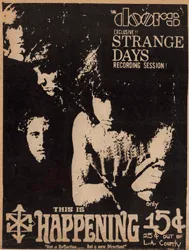
The cover is striking in its simplicity and tells you everything about where this publication sat in the market. Printed in black and white, it presents a high-contrast photographic image of The Doors, the band members rendered in a dark, slightly grainy composition that suits their image well. Jim Morrison is visible at center, his face partially obscured by shadow and print degradation that is characteristic of low-budget newsprint reproduction of the era. The other band members flank him, the whole group pressed together in a tight crop that emphasizes atmosphere over clarity. Above and to the right of the photo, bold block lettering announces an exclusive feature on the Strange Days Recording Session, which immediately flags this issue for any Doors collector scanning a dealer bin. The Doors logo is printed in the upper left corner in their familiar typeface, clean and legible even against the dark photographic background. Along the bottom left, the masthead reads THIS IS HAPPENING in large uppercase sans-serif type, with the price, 15 cents, and the regional identifier, L.A. County, printed to the right. The overall layout is unpolished in the way that genuine period regional teen publications always are: no gloss, no color separation, no design budget to speak of. That rawness is exactly what makes it period-correct and desirable to collectors who understand the difference between a legitimate 1968 artifact and a later reproduction. The staple binding and thin newsprint stock are consistent with the other issues in this run, and the cover image has the slightly overexposed, high-contrast look that was common when photographs were reproduced at this scale and print quality during the period.
The headline promising exclusive Strange Days recording session content is the single most important detail in this issue for Doors collectors. Strange Days was released in September 1967, meaning the recording sessions being referenced here would have taken place in mid-1967, and coverage appearing in the April 1968 issue places this squarely in the wave of post-release fan press that followed the album's commercial rollout. Whether the content inside constitutes genuine behind-the-scenes reporting or aggregated press material repackaged for a teen audience is the kind of question that requires a page-by-page inspection, but the cover promise alone makes this issue distinct from the adjacent numbers in the run. Collectors who have worked through the undated This Is Happening issue and the other variants cataloged here will want this one specifically for that Strange Days angle, as it is not replicated in the surrounding issues. At 14 pages, the content density is low by modern standards, but that is not the point. These publications were ephemeral by design, printed cheaply and distributed locally, which is precisely why surviving copies in reasonable condition are difficult to locate today. The L.A. County regional distribution further narrows the original circulation footprint. For context, publications of comparable regional scope and format from this era, covering major acts at their commercial peak, consistently attract collector interest well beyond what their original price point would suggest. This is not a national newsstand title like Poppin with broader distribution; it is a hyper-local production with a correspondingly small survival rate. Condition will be everything here, as the newsprint stock ages poorly and staple rust is common on surviving copies.
For any collector building a serious archive of Doors-related print ephemera from the 1967 to 1968 period, this issue is a genuine find. The Strange Days recording session coverage is the hook, the regional scarcity is the practical reality, and the condition of any given copy will determine its value on the current market. This is not a magazine you will encounter regularly; when it does surface, it moves quickly among collectors who know what it is.
Log in to leave a comment.